
Maintenance · November 10, 2026 · 7 min read
Gutters Before Winter: Clean, Guard, or Replace?
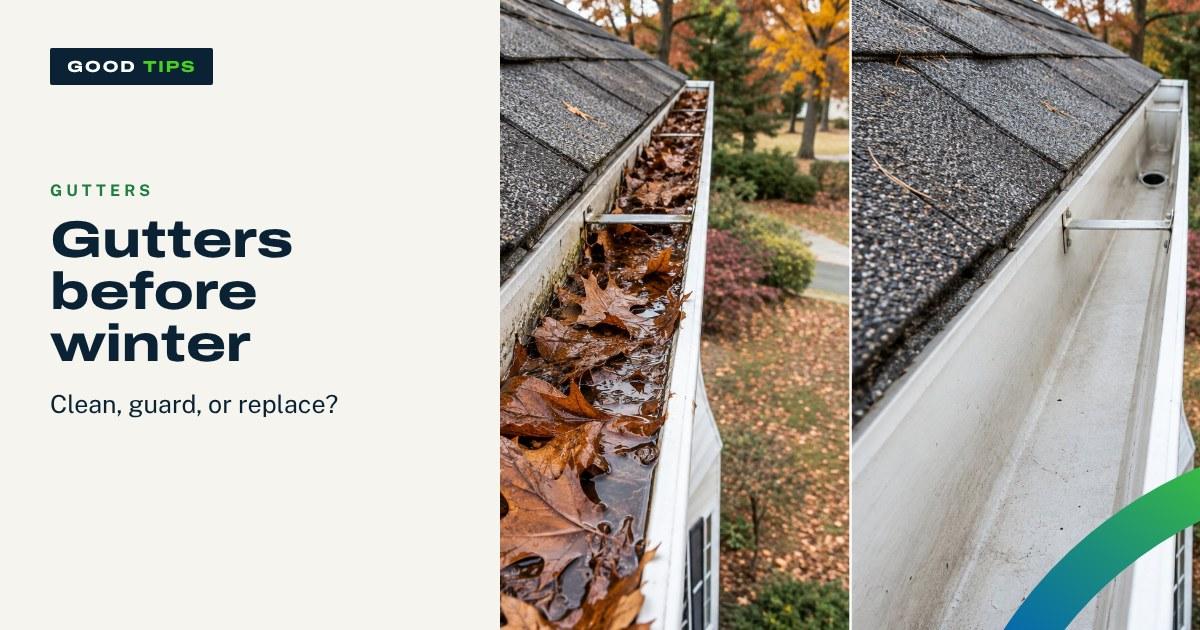
By the middle of November, most of the leaves in the Carolinas are on the ground. A good share of them are also in your gutters. That makes this the one month of the year when it's worth looking up.
Every gutter question comes down to three options: clean them, put guards on them, or replace them. Here's how to tell which one your house needs, and what your gutters have to do with the roof above them.
Why November is the month to look
Gutters do most of their work in the months ahead. Winter in the Carolinas is less about snow and more about long, steady rain, with a few hard freezes in between.
A gutter full of leaves can't move that water. It spills over the front, backs up at the rear, and holds wet debris against the house for weeks. When a freeze comes, the standing water turns to ice, and the weight pulls on every hanger.
Timing matters too. Clean in October and the oaks will fill the gutters again by Thanksgiving. Clean once the trees are bare and you do the job one time.
What a clogged gutter does to the edge of your roof
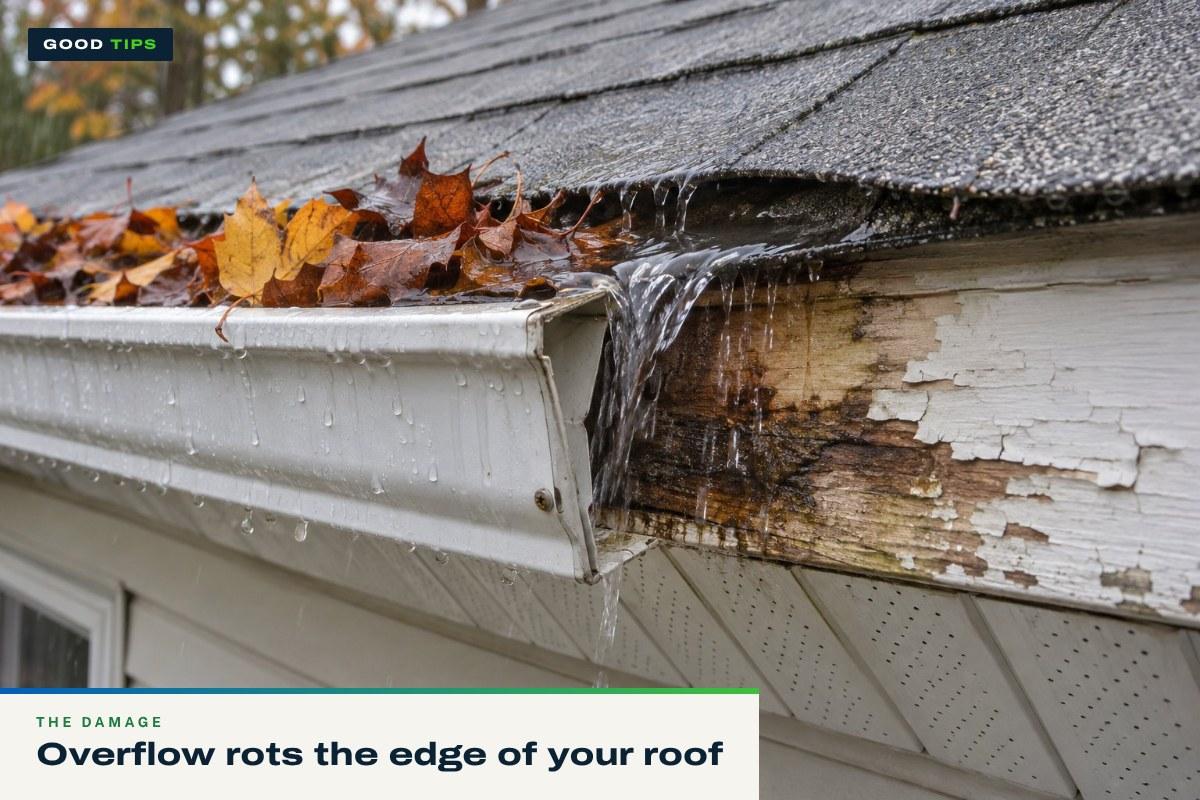
A gutter that can't drain doesn't only spill over the front. The water also rises at the back, where the gutter meets the fascia board and the edge of the roof. From there it reaches three places:
- The fascia. This is the board the gutter is fastened to. Wet wood stops holding fasteners, and the gutter starts to sag and pull away from the house.
- The roof deck edge. The first few inches of plywood under the shingles soak up water from below and go soft.
- The soffit and the wall below. First stains and peeling paint, then rot.
The part designed to protect this area is the drip edge, a strip of metal that steers water off the roof and into the gutter. We explain how it works in Drip Edge: The Smallest Piece of Your Roof Decides Where the Water Goes. A drip edge and a clear gutter work as a pair. Either one alone leaves the wood exposed.
The same overflow causes trouble at ground level. Water that should leave through the downspout lands next to the foundation instead. In Piedmont red clay, which drains slowly, it stays there.
Clean: when that's all you need
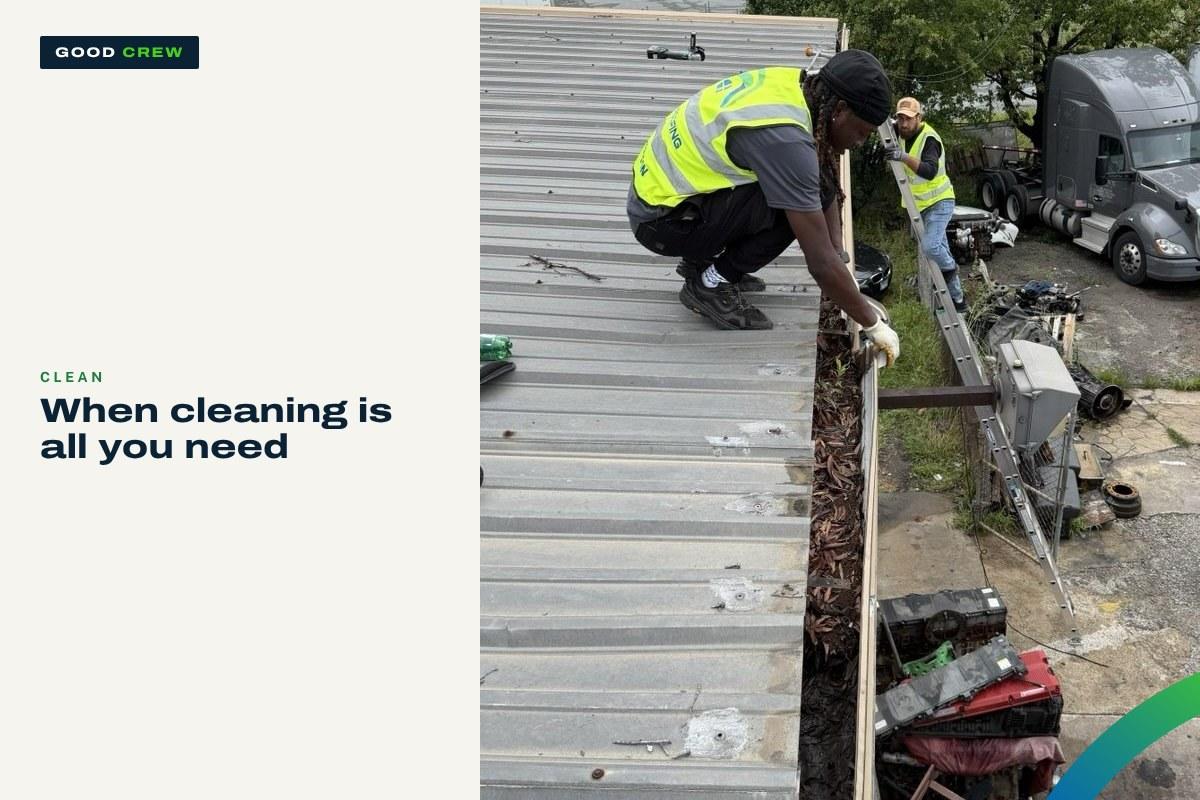
If your gutters are straight, tight to the house, and dry at the seams, cleaning is the whole job. A proper cleaning is more than scooping out leaves:
- Debris removed from every run, not only the easy ones
- Downspouts flushed until water runs freely at the bottom (most clogs sit in the elbows)
- A hose test to confirm water moves toward the downspout and doesn't pool
- A look at hangers, seams, and end caps while someone is up there
Pay attention to what comes out. A heavy layer of shingle granules is one of the 10 signs your roof needs attention.
Most Carolina homes need two cleanings a year: one after the leaves drop and one in spring, after pollen and seed pods. Homes under pines often need a third.
A word on safety. A single-story home on level ground is manageable for many homeowners. Two stories, sloped yards, or anything near a power line is work for someone with the right ladder and equipment. Never clean gutters while standing on the roof edge.
Guard: do you need gutter guards?
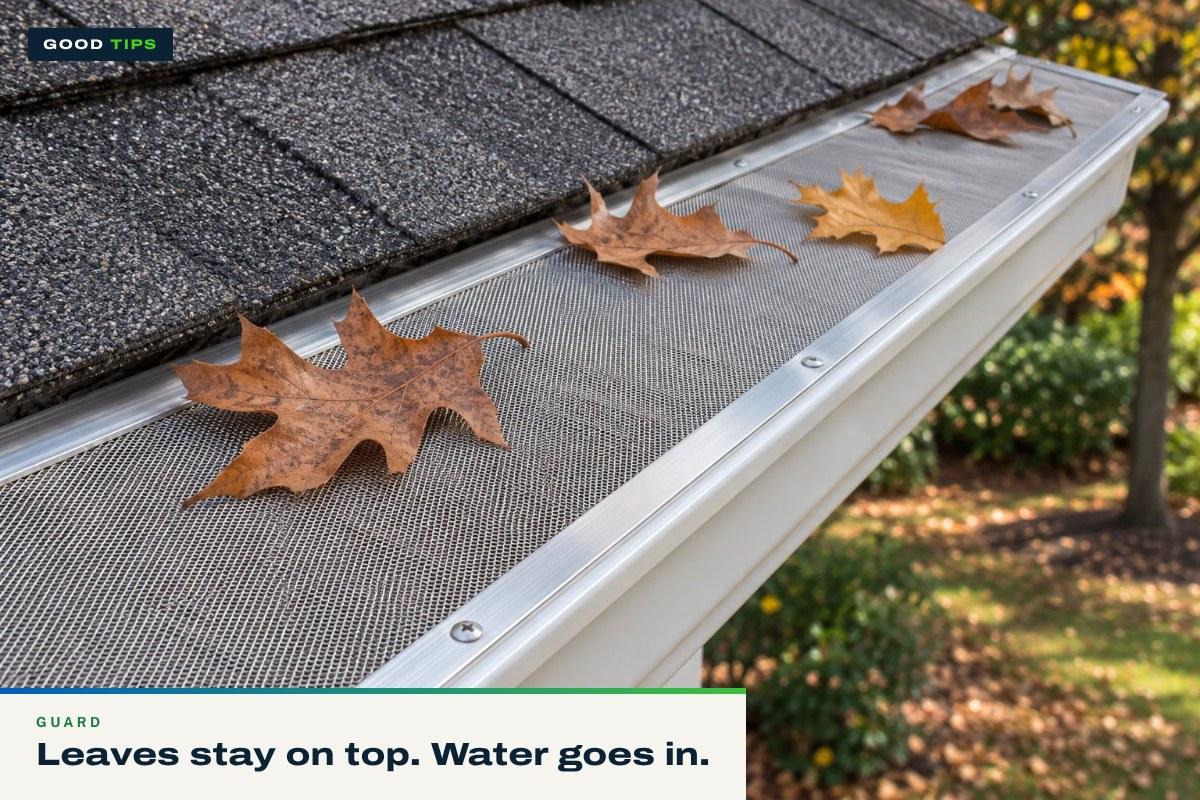
Gutter guards cut down on cleaning. They don't end it. That's the honest way to think about them, and whether they're worth it depends on what grows above your roof.
| Your situation | Are guards worth it? |
|---|---|
| Large trees over the roof, three or more cleanings a year | Usually yes |
| Pines nearby | Yes, with fine mesh only. Needles pass through wider openings |
| Two-story home that's hard to reach | Often yes, for fewer ladder trips |
| Few trees, one cleaning a year does it | Usually not needed |
There are three common types:
- Screens. Simple and effective against leaves. Small debris still gets through.
- Micro-mesh. Fine enough to stop pine needles and shingle granules. The top needs an occasional brushing off.
- Solid covers. Water follows a curved edge into the gutter while leaves slide off. In a heavy downpour on a steep roof, some water can overshoot.
Two things matter more than the type. The guard has to fit the gutter and the roof edge without disturbing the shingles or the drip edge. And it has to go on gutters that are clean, sound, and sloped correctly. Guards on a failing gutter only hide the problem.
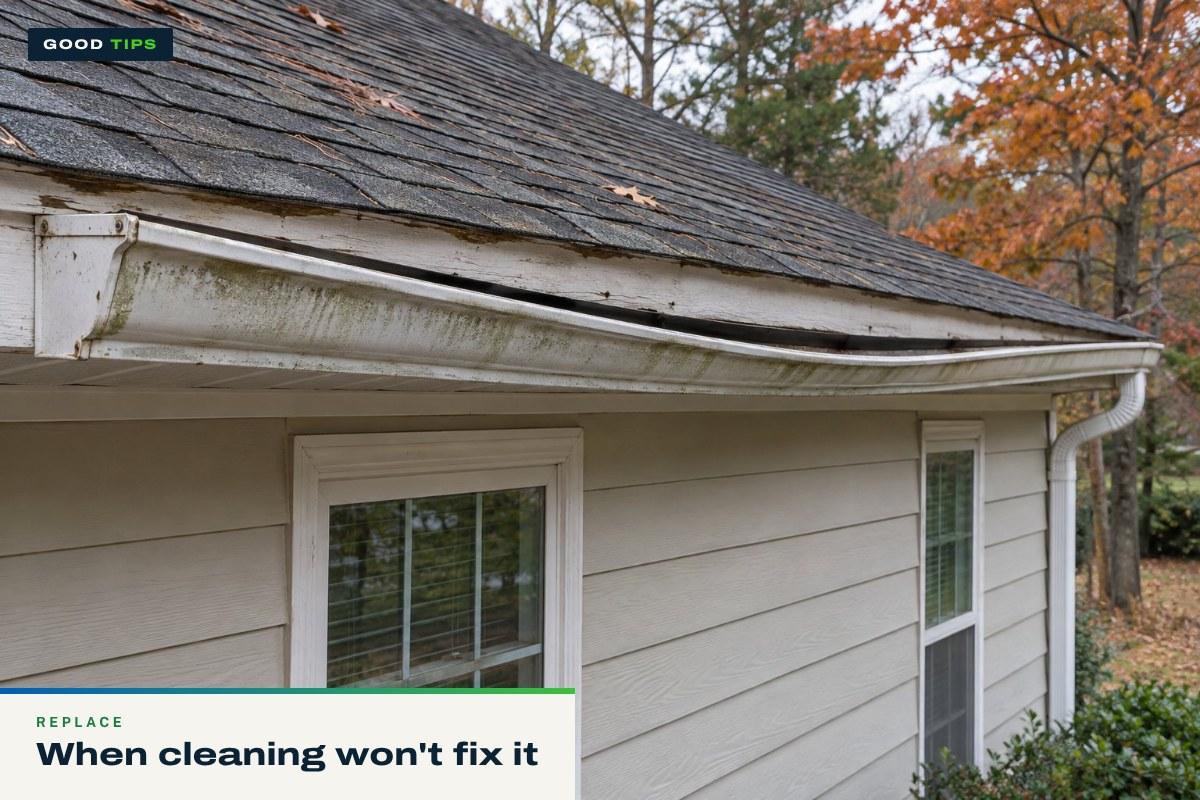
Replace: signs that cleaning won't fix it
Some problems come back no matter how clean the gutter is. These are the ones that point to replacement:
- Sagging or pulling away from the house, especially if re-fastening doesn't hold. The fascia behind it may be soft.
- Standing water a day after rain. The slope is off, or the gutter has bent.
- Seams that leak again after being resealed.
- Cracks, holes, or rust-through in the gutter itself.
- Peeling paint or rot on the fascia behind or below the gutter.
- Trenches in the mulch or soil directly under a gutter run.
- Overflow in ordinary rain even when the gutter is clean. The gutters or downspouts are too small for the roof above them.
One or two trouble spots can usually be repaired. Several along the same run mean the gutter has reached the end of its life, and replacing it costs less than repairing it again every year.
If a roof replacement is in your plans for the next year or two, it makes sense to do both together. The fascia is exposed and can be checked, and the drip edge and gutters get set as one system.
Gutter size: why we recommend six-inch
We can install any gutter size. What we recommend is six-inch gutters with 3x4-inch downspouts, and here is the reasoning.
Many homes in the Carolinas were built with five-inch gutters and 2x3-inch downspouts. That size handles a steady, moderate rain. Our weather is rarely that polite. Summer thunderstorms and tropical systems drop a lot of water in a few minutes, and a large or steep roof sends all of it to the edge at once.
| Five-inch gutter, 2x3 downspout | Six-inch gutter, 3x4 downspout | |
|---|---|---|
| Gutter | Narrower and shallower | Wider and deeper, so it carries more water before it overflows |
| Downspout opening | 6 square inches | 12 square inches, twice as large |
| Leaves and small twigs | Catch in the outlet and elbows more easily | Pass through more easily |
The downspout matters as much as the gutter. A gutter can only empty as fast as its downspout lets it, and the outlet is where most clogs start. Doubling the opening lets water leave faster and gives debris more room to wash through.
The larger size also sits better under the roof edge. A wider gutter catches fast-moving water that can shoot past a narrow one, which is common on steep slopes and metal roofs.
If your current gutters overflow in a normal storm even when they are clean, size is the likely reason.
What moves the cost of gutter replacement
Gutter replacement is priced by the foot, and a handful of things move the number up or down:
- Total length of gutter and the number of downspouts
- Height of the house and how easy it is to reach
- Gutter material (aluminum is the most common; steel and copper cost more)
- Number of corners, since each one is cut and sealed by hand
- Condition of the fascia, because rotted boards are replaced before new gutters go up
- Whether gutter guards are added
- Removal and disposal of the old gutters
Because the price depends on measured feet and on the condition of the wood behind the old gutter, an accurate quote starts with a look at the house. Ours is free.
A five-minute check from the ground
You don't need a ladder for any of this.
- Walk around the house and look along each gutter run. It should be a straight line with a slight slope toward the downspout. Dips mean water is pooling.
- Look for gaps between the gutter and the fascia board.
- Check the fascia and the siding below for streaks, stains, or peeling paint.
- Look for plants growing out of the gutter. Green on top means soil inside.
- Check the ground under each run for trenches in the mulch or splash marks on the foundation.
- During the next rain, step outside for one minute. Water should be coming out of the downspouts, not over the front of the gutter or down the wall behind it.

The short version
Clean your gutters if they're sound. Add guards if the trees above make cleaning a constant chore. Replace them if they sag, leak at several seams, or hang from fascia that has started to rot. Check now, while the leaves are down and before the winter rain arrives.
Not sure which one applies to your house? We look at the gutters, the fascia, and the roof edge together, across North and South Carolina, and send you photos of what we find. Schedule a free inspection or call (800) 698-3888. You can read more about our gutter work on the gutters page.
Questions about your own roof?
Free inspection, honest answer, financing available — schedule here or call (800) 698-3888.